

19:49
:format(webp):quality(80)/https%3A%2F%2Fwww.gandul.ro%2Fwp-content%2Fuploads%2F2026%2F10%2F8137588-hepta_mediafax_foto-abacapress_hepta-1280x853.jpg)
:format(webp):quality(80)/https%3A%2F%2Fwww.gandul.ro%2Fwp-content%2Fuploads%2F2026%2F04%2Ffacebook-gandul-1-1280x720.png)
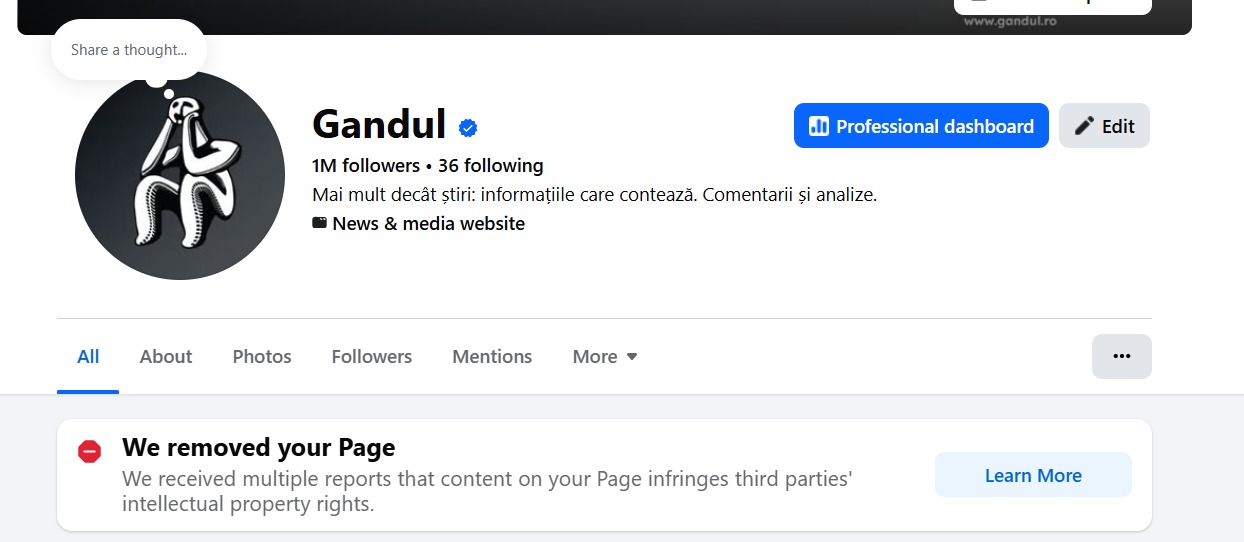
The company Meta, which operates the Facebook platform, shut down the Gândul newspaper’s page on February 22, 2026, without any warning or clear explanation. In a single day, the page disappeared and Gândul’s traffic collapsed, with an immediate loss of 6–7 million daily views and nearly 200 million monthly views on Facebook and on the website.
The newspaper’s social media extension—certified by Facebook with a “blue checkmark”—had over 1 million followers and generated hundreds of millions of views each month. Facebook is drastically limiting the public’s right to access information from the Gândul platform.
In the absence of explanations regarding the restriction, and considering that the newspaper has acted in good faith and followed journalistic ethics in informing the public, we consider this action by Facebook to be an attack on press freedom in general and on an independent publication in particular, as well as a violation of rights guaranteed by the Romanian Constitution and the law, as we will demonstrate below.
It is astonishing how an entity like Facebook can wipe out, with a single click, years of work by journalists. We are witnessing an abuse by an entity among a group of giants that, although they operate and collect hundreds of millions of euros from Romanian citizens, practically do not exist in Romania, do not pay taxes to the Romanian state, and are not accountable to authorities. There are several examples, including companies such as Uber, which are protected and engage in unfair competition with Romanian entrepreneurs.
We will discuss all of this in detail in the next article, as is customary at Gândul, with documents and figures.
We hereby call on all authorities that protect citizens, the Constitution, rights and freedoms, as well as those responsible for regulating free competition, to take action regarding this measure, which we consider an abuse of power: the Romanian Parliament, the Romanian Government, the National Authority for Administration and Regulation in Communications (ANCOM), the Competition Council, the European Commission through the Directorate-General for Competition, etc.
Facebook’s action, its dominant market position, and its ability to abuse this status represent a serious attack on freedom of expression and free-market competition.
Restricting an extension of the online newspaper through which Gândul articles reached over 1 million users implicitly means restricting press freedom and freedom of expression.
At Gândul, we sincerely believe in the role of the press to criticize those in power, regardless of political color—but with arguments, evidence, and solid documentation. We do not consider it a mere coincidence that the Facebook page was shut down, given that the newspaper is the strongest opposition publication in Romania, especially since, as we will show below, Gândul resolved amicably all the “issues” indicated by Facebook that led to the shutdown, and there is no real reason for the page to remain closed.
Freedom of expression is guaranteed by Article 30 of the Constitution:
We consider Facebook’s action to violate at least three of the four provisions of Article 30 of the Romanian Constitution regarding freedom of expression.
Facebook is seriously disrupting free competition in Romania’s media market. By preventing Gândul from distributing its articles on Facebook through its own page, the newspaper suffers major competitive harm.
We are unable to reach Gândul readers and followers on Facebook, while other competing newspapers have unrestricted access. This results in financial losses that our competitors do not bear. Consequently, the company’s operational capacity declines, along with its ability to invest, while other companies’ revenues are unaffected by Facebook.
Thus, by restricting access to the page, Facebook directly intervenes and violates the principle of free competition between companies—an essential pillar of democracy and capitalism.
Beyond principles, Facebook is also violating Competition Law no. 21/1996, Article 6:
“The abusive use of a dominant position […] through anti-competitive practices that have as their object or effect the restriction, prevention, or distortion of competition is prohibited.”
Facebook continues to refuse to provide a clear explanation for its action and has cited copyright infringement. Such copyright disputes, inherent in publishing activity, were resolved directly within the platform with the companies that filed the complaints. Nevertheless, despite all claims being resolved, Facebook continues to penalize Gândul.
Below is the timeline of events, along with correspondence with Facebook:
The restriction was applied to the Gândul Facebook account on February 22, between approximately 10:00–12:00.
At the same time, we received a notification stating that one of our videos allegedly violated intellectual property rules. However, when attempting to access the page, no reason for the suspension was provided.
We immediately opened a ticket with Meta, which responded requesting additional information, which we provided.
We also contacted the company that filed the intellectual property complaint.
Subsequently, all complaints were resolved amicably, as shown in the screenshot below.
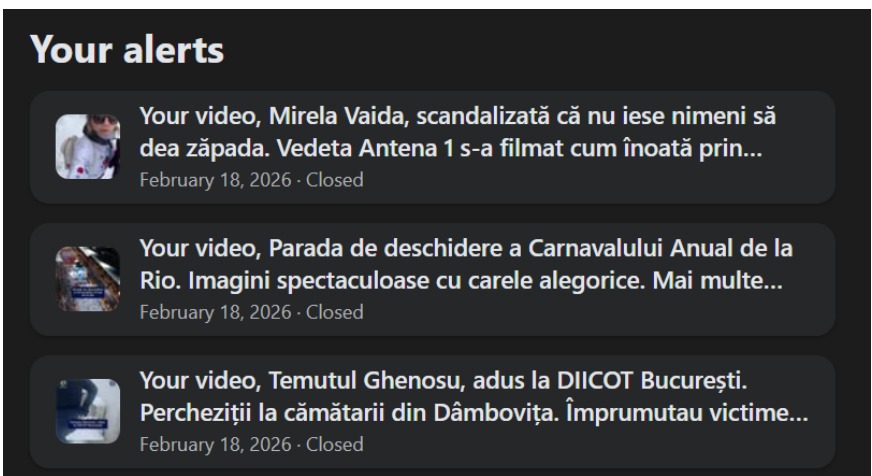
As can be seen, they are marked “Closed.”
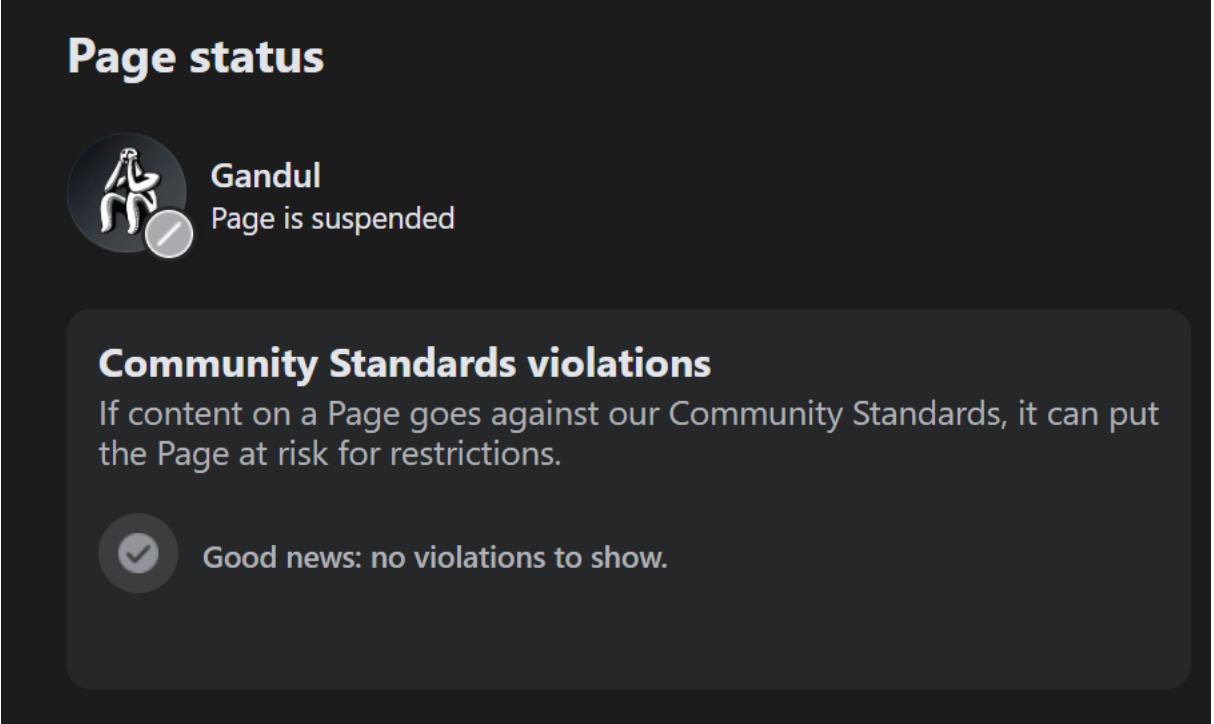
Furthermore, Facebook itself states that we did not violate any “community standards.”
Despite this, we have received no further response, and for five weeks the Gândul page has been unable to publish.
In April 2025, no fewer than 200 media organizations in France filed a lawsuit against Meta—the parent company of Facebook and Instagram. This joint legal action has been described as “historic.”
The case is being heard at the Paris Economic Activities Court.
Among the plaintiffs are major names in French audiovisual and print media, such as TF1, France Télévisions, Radio France, and Le Figaro.
Traditional media dissatisfaction with the business model used by tech giants is deep and long-standing, not only in France. Companies like Meta and Google attract large advertising budgets by using news produced by media organizations.
At the same time, Meta is accused of collecting massive amounts of personal user data without informing or obtaining consent, constituting a “flagrant violation” of GDPR.
According to plaintiffs, Meta exploits this data to deliver targeted advertising.
Ultimately, Meta has captured the majority of advertising investments, to the detriment of the media.
The EU fined Meta €200 million ($227 million) for violating rules on the use of personal data on Facebook and Instagram.
The fine targeted Meta’s “pay for privacy” system, where users must either pay to avoid data collection or consent to data sharing to use the platforms for free.
*Meta accused of “economic parasitism”*
In March 2025, another lawsuit was filed in France against Meta by:
This is the first major AI-related lawsuit in France against a tech company for allegedly using copyrighted works without authorization to train Meta’s generative AI model, Llama.
The plaintiffs claim Meta illegally used copyrighted works (French books) without permission.
They accuse Meta of:
Meta’s (Facebook’s) abusive practices are documented in other countries as well. The fact that a private company, with no headquarters in Romania, which does not pay taxes locally and is not accountable to authorities, can affect fundamental rights of Romanian citizens with a single click represents a direct threat not only to individual freedoms but to democracy itself.
AUTORUL RECOMANDĂ:
:format(webp):quality(80)/https%3A%2F%2Fwww.gandul.ro%2Fwp-content%2Fuploads%2Fsfm%2F2026%2F10%2F1592228965%2F646dbd8a044ce8da5d5afe439eda5475-t.jpg)
:format(webp):quality(80)/https%3A%2F%2Fwww.gandul.ro%2Fwp-content%2Fuploads%2Fsfm%2F2026%2F10%2F1710250938%2F5e8377282180a613ca40a4ba97c944bf-t.jpg)
:format(webp):quality(80)/https%3A%2F%2Fwww.gandul.ro%2Fwp-content%2Fuploads%2Fsfm%2F2026%2F10%2F1576590984%2Fa0b0ab27e35574ba02d0359bf8aed72d-t.jpg)
:format(webp):quality(80)/https%3A%2F%2Fwww.gandul.ro%2Fwp-content%2Fuploads%2Fsfm%2F2026%2F10%2F1576590920%2F19698609070e6dfe963ed91b58392e62-t.jpg)
:format(webp):quality(80)/https%3A%2F%2Fwww.gandul.ro%2Fwp-content%2Fuploads%2Fsfm%2F2026%2F10%2F1576590664%2F0ae89d56e8a032c56138d0cf6878f0c9-t.jpg)
:format(webp):quality(80)/https%3A%2F%2Fwww.gandul.ro%2Fwp-content%2Fuploads%2Fsfm%2F2026%2F10%2F1788417834%2Fbea46440532d8f602ce21f4efb311847-t.jpg)
:format(webp):quality(80)/https%3A%2F%2Fwww.gandul.ro%2Fwp-content%2Fuploads%2F2026%2F10%2Fministerul-finantelor-prelungeste-reducerea-temporara-cu-25-a-accizei-la-motorina-pana-la-finalul-lunii-octombrie-20264-1280x817.jpg)
:format(webp):quality(80)/https%3A%2F%2Fwww.gandul.ro%2Fwp-content%2Fuploads%2Fsfm%2F2026%2F10%2F1741781337%2Fba1dd0e927d602b1f5d8a9aa392cb09c-t.jpg)
:format(webp):quality(80)/https%3A%2F%2Fwww.gandul.ro%2Fwp-content%2Fuploads%2Fsfm%2F2026%2F10%2F1658491671%2F911601b21d0e3cf86c3ba869c49db115-t.jpg)
:format(webp):quality(80)/https%3A%2F%2Fwww.gandul.ro%2Fwp-content%2Fuploads%2Fsfm%2F2026%2F10%2F1576590808%2Fd3b20c1fa2981b28200c3750d04ff7af-t.jpg)
:format(webp):quality(80)/https%3A%2F%2Fwww.gandul.ro%2Fwp-content%2Fuploads%2Fsfm%2F2026%2F10%2F1723469374%2Fa16443b40e7b81367ba7315a5091f109-t.png)
:format(webp):quality(80)/https%3A%2F%2Fwww.gandul.ro%2Fwp-content%2Fuploads%2Fsfm%2F2026%2F10%2F1741781353%2Fd04cf7df0fc7a174396414a7e15f1a58-t.jpg)
:format(webp):quality(80)/https%3A%2F%2Fwww.gandul.ro%2Fwp-content%2Fuploads%2Fsfm%2F2026%2F10%2F1738660745%2F4d9fab47d57504ad9e02dd1ed7d45f28-t.png)
:format(webp):quality(80)/https%3A%2F%2Fwww.gandul.ro%2Fwp-content%2Fuploads%2Fsfm%2F2026%2F10%2F1576590808%2F317db9638ea665e834a5d7e4759f800d-t.jpg)
:format(webp):quality(80)/https%3A%2F%2Fwww.gandul.ro%2Fwp-content%2Fuploads%2Fsfm%2F2025%2F08%2F1576590698%2F72097a8094fab0687bedb13867629596-t.jpg)
:format(webp):quality(80)/https%3A%2F%2Fwww.gandul.ro%2Fwp-content%2Fuploads%2Fsfm%2F2026%2F10%2F1608198304%2Fdf8c2dd9962c1924864994dfa912f0f6-t.jpg)
:format(webp):quality(80)/https%3A%2F%2Fwww.gandul.ro%2Fwp-content%2Fuploads%2Fsfm%2F2026%2F10%2F1585817475%2Fc588e421eb653e8cee3d13a4a2b9a77b-t.jpg)
:format(webp):quality(80)/https%3A%2F%2Fwww.gandul.ro%2Fwp-content%2Fuploads%2Fsfm%2F2026%2F10%2F1788417798%2F5faf77aaf2b90db22d98d8b31796a3cb-t.jpg)
:format(webp):quality(80)/https%3A%2F%2Fwww.gandul.ro%2Fwp-content%2Fuploads%2F2026%2F10%2F8162845-mediafax_foto-alexandru_nechez-1280x854.jpg)
:format(webp):quality(80)/https%3A%2F%2Fwww.gandul.ro%2Fwp-content%2Fuploads%2F2026%2F10%2Faeroportul-timisoara-isi-muta-temporar-zborurile-la-arad-in-noiembrie-care-sunt-exceptiile-si-ce-trebuie-sa-verifice-pasagerii2-1280x853.jpg)
:format(webp):quality(80)/https%3A%2F%2Fwww.gandul.ro%2Fwp-content%2Fuploads%2F2026%2F10%2Fimages-2026-10-15t190229-961.jpg)
:format(webp):quality(80)/https%3A%2F%2Fwww.gandul.ro%2Fwp-content%2Fuploads%2F2026%2F10%2F835748490_1473769418140528_8723514789015738017_n-e1791273076508-1280x655.jpeg)
:format(webp):quality(80)/https%3A%2F%2Fwww.gandul.ro%2Fwp-content%2Fuploads%2F2025%2F12%2Fdumitru-dragomir-nadia-comaneci-traieste-ca-boieroaica-in-sua-cu-renta-viagera-din-romania-are-peste-5-000-de-euro-1280x853.jpg)
:format(webp):quality(80)/https%3A%2F%2Fwww.gandul.ro%2Fwp-content%2Fuploads%2F2026%2F10%2Fhttps___www-gandul-ro_wp-content_uploads_2026_07_criza-politica-blocheaza-agricultura-in-timp-ce-romania-este-traversata-de-un-episod-de-furtuni-sistemul-antigrindina-ramane-nefunctional1-scaled-1.webp)